The week stocks fell 8.6%: finance media at their gloomiest since April 2025
The S&P 500 lost 8.6% from 16 to 20 November 2026, its worst week since April 2025. Finance media sentiment fell on every day of the week and ended at its lowest level since April 2025. Here is how the week unfolded, day by day, and where the mood and the outlook stand now.
- By
- FinSenty Editorial
- Published
- Data as of
- (UTC)
- Period
- 16 Nov 2026 – 20 Nov 2026
In short
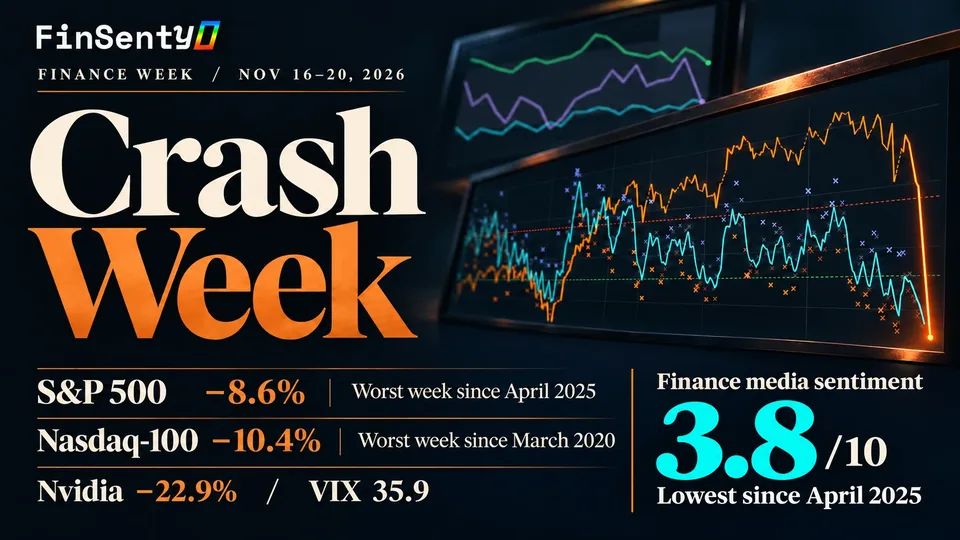
- The S&P 500 fell 8.6% in the week to Friday, 20 November 2026. That is its worst week since April 2025. The Nasdaq-100 fell 10.4%, its worst week since March 2020.
- The S&P 500 closed lower on all five days. Friday was the hardest: the S&P 500 lost 3.7% and Nvidia 14%.
- Finance media sentiment fell every day. At 3.8 out of 10 it is now at its lowest level since April 2025.
- Outlook calls are cautious on every horizon. Mid-term calls fell the most and are now the most cautious of the past year.

Five days, one direction
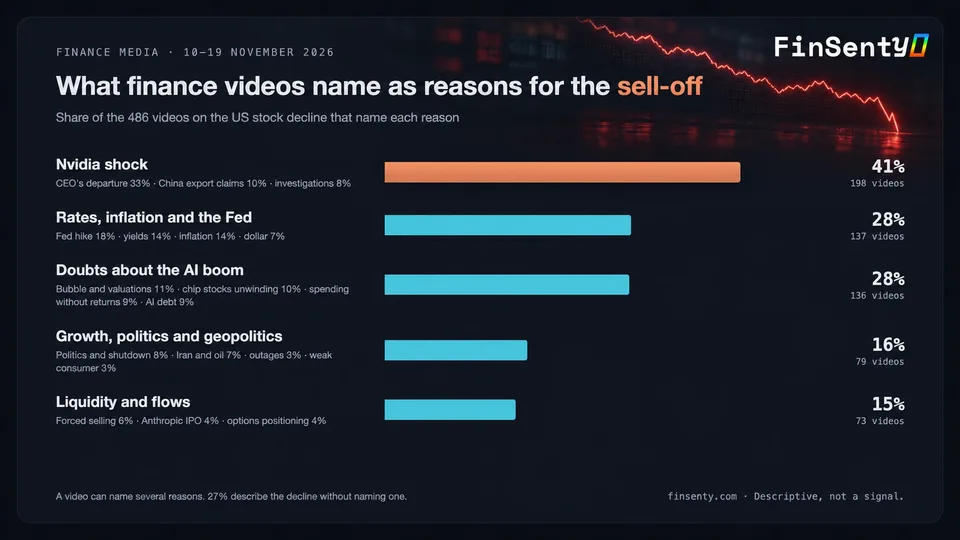
On Friday, 13 November, the S&P 500 closed at 7,562. A week later it stood at 6,910. In between came a run of news that the finance videos followed hour by hour: the leadership crisis at Nvidia, new rules for chip exports, a Fed that keeps talking about higher rates, the biggest IPO on record and, on Friday, a report about an SEC investigation.

Here is the week, day by day.
Monday, 16 November: Nvidia without its founder
The S&P 500 fell 1.9% and the Nasdaq-100 2.7%. Nvidia lost 4.1% to $156.14. The company's future after the exit of chief executive Jensen Huang was the main topic in the finance videos. Reports of outages at major US banks and a ground stop at US airports came on top. Many videos also pointed to a 10-year yield above 5.1% and to talk of a larger rate hike in December.
Tuesday, 17 November: new chip rules, then Nvidia's results
The S&P 500 fell another 1.0%, the Nasdaq-100 0.7% and the Dow 1.6%. The US tightened its rules for exports of AI chips. Retail sales for October rose 0.2%, as expected. The S&P 500 closed below its 200-day average for the first time since 7 April 2026. After the close, Nvidia reported quarterly sales of $115.8 billion and gave a forecast of $130 billion.
Wednesday, 18 November: the Fed minutes
Stocks opened higher after Nvidia's forecast, but the gains did not last. Nvidia closed 2.9% lower at $150.96. In the afternoon the Fed published the minutes of its last meeting: almost all participants saw another rate hike as likely to be appropriate, and a couple considered steps larger than a quarter point. The dollar rose to a 19-month high. The Dow fell 1.1% to a five-month low, while the Nasdaq-100 gained 0.4%. The S&P 500 slipped 0.2%.
Thursday, 19 November: the Anthropic IPO
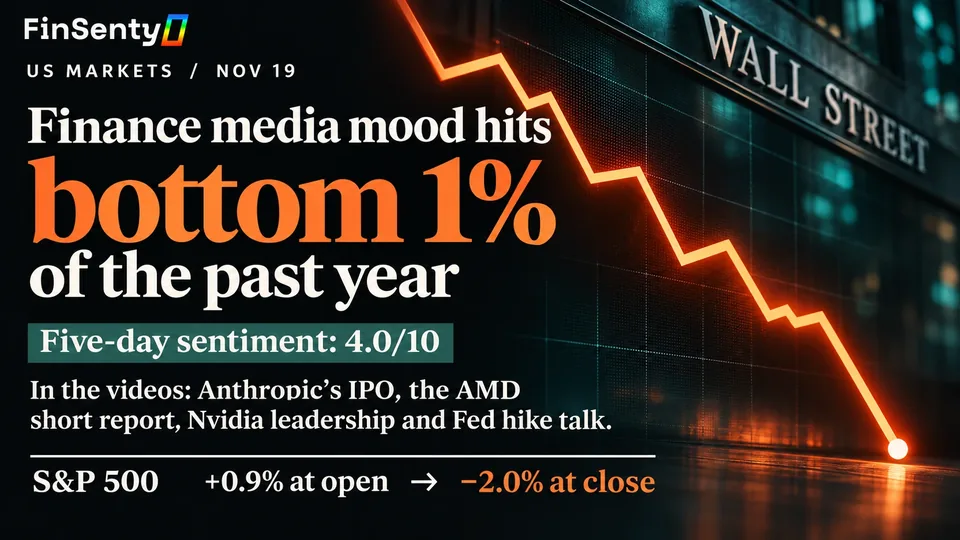
Anthropic started trading. Priced at $83, it opened at $111.50 and closed at $97.17. The S&P 500 opened 0.9% higher and closed 2.0% lower, at 7,176. The Nasdaq-100 fell 2.2%. A short seller published a report on AMD, which fell 7.7%. A Philadelphia Fed survey of factories fell to a six-month low, and in the evening the Philadelphia Fed's president said the Fed had more tightening to do.
Friday, 20 November: the hardest day
Stocks in Asia fell sharply overnight. During the US morning, Reuters reported that the SEC's investigation of Nvidia is looking at the company's accounting. Nvidia fell 14.0% to $125.53. Anthropic fell 8.5% to $88.91, still above its IPO price.
The S&P 500 lost 3.7% and closed at 6,910, below 7,000. The Nasdaq-100 lost 5.6%, the Dow 1.9%. The VIX closed at 35.89, its highest close since April 2025. Treasuries rose, and the 10-year yield fell to 4.95%. Gold fell 4.6%. Fed Governor Lisa Cook said she sees little evidence that inflation is coming down. It was also the monthly options expiry.
The week in numbers
From Friday to Friday, the S&P 500 fell from 7,562 to 6,910 (-8.6%), the Nasdaq-100 from 27,944 to 25,029 (-10.4%) and the Dow from 52,348 to 48,147 (-8.0%). Nvidia lost 22.9%, from $162.85 to $125.53. The VIX almost doubled, from 19.30 to 35.89. Gold fell 9.5%, from $3,886 to $3,515, and WTI crude 5.8%, from $88.56 to $83.41. Treasuries were the exception: their prices rose, and the 10-year yield fell from 5.14% to 4.95%.

How the mood moved
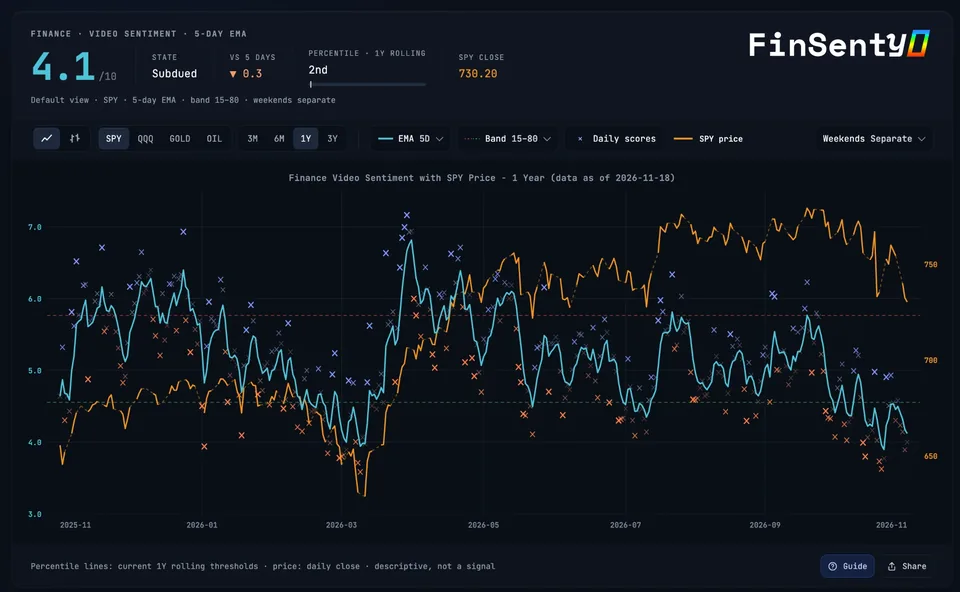
Our sentiment score measures how positive or negative finance commentary sounds, on a scale from 1 to 10. Its five-day average fell on every day of the week: from 4.32 on Monday to 3.98 on Thursday and 3.76 on Friday. Since Sunday, 15 November, it is down 0.6.
That puts it at the very bottom of the past year. To find a lower reading, you have to go back to 5 to 8 April 2025, the days of the tariff sell-off. The score for Friday alone was 3.32, the lowest daily score of the past year.

Over the full year, the picture is clear: the five-day average is below where it stood during the sell-off in late March 2026, and well below its usual range.

The outlook
The outlook score asks where the videos think prices are headed. It runs from 1 to 10, and 5 to 6 is the neutral band.
All horizons together stand at 5.19 on 20 November, down 0.15 from 15 November. That is inside the neutral band, but in the 1st percentile of the past year. The low of the year was 5.10, on 24 July 2026. By horizon, as five-day averages:
| Horizon | 20 November 2026 | Compared with the past year | Change since 13 November |
|---|---|---|---|
| Short-term | 4.88 | 9th percentile, more cautious than usual | -0.07 |
| Mid-term | 4.77 | 0th percentile, more cautious than usual | -0.70 |
| Long-term | 5.56 | 2nd percentile, more cautious than usual | -0.33 |
The mid-term calls are the story of the week. They stood at 5.69 on Wednesday and dropped to 4.77 by Friday, their lowest point of the past year. Short-term calls were already cautious and stayed there. And the long-term calls, which usually sit above the neutral band, have slipped inside it.

What the videos talked about

We read 483 finance videos published from 16 to 20 November. In the seven days to Friday, mega-cap tech and AI came up in 62.6% of finance commentary, in the 99th percentile of the past year; the average over that year is 44.4%. Earnings rose to 27.1%, up 10.2 points on the week before. Credit and liquidity stress came up in 20.5%, in the 90th percentile. Inflation fell to 10.4%, down 14.2 points, the only unusual weekly change among the main topics.
Rates and central banks came up in 21.6% of commentary, down 4.3 points, geopolitics and policy in 18.3%, down 7.3, narrow leadership in 16.8%, down 2.4, and growth and recession in 9.9%, down 0.7.

By Friday the videos split into two camps. One camp sees signs of a washout: the VIX above 30, extreme fear readings, put positioning they describe as the most negative since April 2025, and tech valuations they call the cheapest in years. Several of them expect a bounce soon. The other camp sees more to come: a Fed that is still expected to raise rates in December, comparisons with the sell-off in late 2018, and talk of a recession within a year. A third group expects both: a short bounce first, then lower lows.
Where things stand
The S&P 500 closed 11.6% below its record close of 7,818.93 on 6 October 2026. A fall of more than 10% is what markets call a correction. The SPY closed at 689.81, its lowest close since 13 April 2026.
Measured from Friday close to Friday close, the SPY fell 8.6% this week. In the past three years only one week was worse: the week to 4 April 2025, with -9.1%. The next largest falls were much smaller: -4.1% in the week to 6 September 2024, -3.1% in the weeks to 7 March 2025 and 19 April 2024, -2.7% in the week to 6 November 2026, and -2.5% in the weeks to 23 May 2025 and 5 June 2026.

Finance media now sound gloomier than at any point since April 2025, and their calls for the coming months are the most cautious of the past year. Next week is short: US markets are closed on Thursday, 26 November, for Thanksgiving.
This article describes what the commentary says; it does not judge whether it is right.
Continue with FinSenty Premium
The rest of this analysis is for FinSenty Premium members.
See Premium plansAlready a member? Sign in
Sources and data
S&P 500, Nasdaq-100, Dow Jones, SPY, Nvidia, Anthropic, AMD, VIX, 10-year Treasury yield, front-month gold and WTI futures: daily closes from 13 to 20 November 2026, regular session for stocks and indices, settlement for futures. Weekly comparisons from weekly closes since 2019. SPY weekly changes from the last close of each week since November 2023.
News of each day: company, government and central bank announcements and wire reports from 16 to 20 November 2026.
FinSenty finance media sentiment (1 to 10), five-day average of daily scores, UTC days, weekends shown separately. Rank against the daily values of the past year.
FinSenty finance media outlook score (1 to 10, neutral band 5 to 6) for the short, mid and long horizon and all horizons combined, five-day average, UTC days.
FinSenty finance topics: share of commentary naming a topic, seven-day window to 20 November 2026, ranked against the past year.
Videos: the 483 finance videos published from 16 to 20 November 2026 (UTC); a video can name several topics.
Data through 20 November 2026.
This post reflects media commentary up to its data day, 20 Nov 2026, and is not investment advice. Today's values are on the live Finance overview.